


Home Pin 1
Pull the pin games ask a single question over and over: in what order. Every pin is drawn, every consequence is physical, and there is no way to take one back.
Home Pin wraps that around a story. Edward has moved into an abandoned house, and the money you collect by solving levels goes into rebuilding it. The renovation is a progress bar with pictures, and it works, because a puzzle that pays out into something visible is a puzzle people finish.
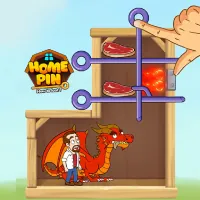
The levels themselves are the real thing though: a small physics diagram with two or three pins holding it together, and exactly one order that works.
How to play Home Pin 1
Each level is a sealed picture with pins in it.
- Click or tap a pin to pull it out.
- Whatever it was holding is released, and gravity takes over.
- Liquid flows, objects fall, enemies move.
- Collect the gold and reach the goal to finish the level.
- Pull the wrong pin first and the level usually fails immediately.
Read the diagram, not the pins
Every level is a container problem. There is something that needs to go somewhere, and something else that must not get there.
The pins are just the taps. Before touching any of them, look at what each one is holding and where that thing would go if released. Half the levels solve themselves the moment you ask that question rather than clicking to find out.
No undo
That is the design. Pull the wrong pin and you restart, which is quick and costs nothing but pride.
It also means experimenting is a legitimate strategy on levels you cannot read. Two or three restarts to learn what each pin does is often faster than staring.
Tips and strategy
Work out where the failure is
Every level has one way to lose, and it is usually more obvious than the way to win.
Lava that must not touch the gold. An enemy that must not reach Edward. A container that must not overflow. Identify that first, because the solution is almost always the order that keeps it contained for longest.
Ask what each pin releases
Take them one at a time in your head:
- What is this pin currently holding?
- If it goes, where does that thing travel?
- Does it end up somewhere useful, somewhere harmless, or somewhere fatal?
Any pin whose answer is fatal is not first. That usually leaves you with two candidates rather than five.
Order beats timing
These puzzles are almost never about reaction speed. Nothing needs to be pulled at a precise moment.
If a level seems to require timing, you have probably got the order wrong. The right sequence tends to feel unhurried, with each release finishing before the next matters.
Use the enemies
Later levels put obstacles in the way that can be turned into tools. Lava that kills Edward also kills whatever is chasing him. A falling block that blocks your route also blocks theirs.
When a level looks like it has one too many threats, check whether two of them can be pointed at each other.
Gold is optional until it is not
Some levels can be completed without collecting everything. Whether that is acceptable depends on how much you want the renovation to progress, since the money is what pays for it.
If a level has one awkward coin, finish it first without the coin, then replay knowing the layout. That is faster than restarting twenty times for a full clear on a level you have not solved yet.
The renovation is the reason people continue
Pull the pin games are numerous and mostly interchangeable. What separates the ones people play for a week from the ones they close after ten levels is usually not the puzzles.
Here the money you collect goes into rebuilding the house, and the house visibly changes. That gives a run of levels a destination, which matters more than it should, because the puzzles themselves are short and self contained.
It is worth knowing that this is a pacing device rather than a mechanic. Nothing about the renovation changes how a level is solved, and there is no advantage to be gained by saving up. It exists to give the next level a reason.
When to restart
Immediately, once the first pin has gone wrong. There is no recovering a physics puzzle after the liquid has left the container, and continuing only wastes the seconds it takes to watch it fail.
Levels are diagrams, not scenes
The artwork encourages you to read each level as a picture of a room. It is more useful to read it as a schematic.
Strip out the decoration and what remains is a small number of containers, a small number of things that flow or fall, and two or three valves. Every level in the game is that, dressed differently.
Once you start seeing them that way the difficulty drops noticeably, because you stop being distracted by which enemy is which and start asking the only question that matters: what is holding what, and what happens when it stops.
Similar things here
Free The Key is the sliding block version of the same instinct, Pull Pin is the plainer take on it, and Snail Bob 7 puts the same order of operations thinking into a level with a character walking through it. More in puzzle.
More games like this

Play our free daily puzzles See all →
Made by us. One a day, the same for everyone, no sign up.
Last updated
Frequently asked questions
How do you play Home Pin?
You pull pins out of a physics diagram in the right order, so that liquid, objects and enemies end up where you need them and away from where they would ruin the level.
Is there an undo?
No. A wrong pin usually ends the level immediately, so restarting is the only option, and it is quick.
Does timing matter?
Almost never. If a level seems to need precise timing, the order is probably wrong. Correct solutions tend to feel unhurried.
What is the money for?
It rebuilds Edward’s house, which acts as the progress system across levels rather than as anything that changes the puzzles.
What is the best way to approach a hard level?
Find the way to lose first. Identify what must not touch what, and the safe order usually becomes obvious.
Is it free?
Yes, free in the browser with nothing to install and no account.