Jewel Shuffle


Free daily card games
A new deal every day, solved before it goes live, so it can always be won.

Jewel Shuffle
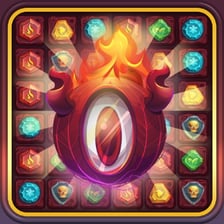
Jewel Shuffle is a match three with nothing added to it. No story, no map, no characters, no energy meter. A grid of gems, a swap, and a board that falls into the space you made.
There is a case for that. The genre has spent a decade bolting things onto the front of a mechanic that was already complete, and the games that leave it alone are the ones people return to when they want twenty minutes rather than a commitment.
What it does keep is the only thing that matters: the cascade. Clear three gems, watch what falls, and find out whether the pieces landing behind them make another line by themselves.
How to play Jewel Shuffle
A grid of coloured gems fills the board.
- Click a gem, then the one next to it, to swap them. Dragging works too.
- The swap holds only if it creates a line of three or more of one colour.
- Matched gems disappear, everything above drops, new gems enter from the top.
- If the falling gems form lines, those clear as well and each link pays more than the last.
- Four or five in a line, or a match bent into an L or a T, makes a gem that clears far more.
What a cascade is worth
Three gems cleared by your swap are worth three gems. Three gems that trigger two further matches on the way down are worth several times that, for the same single move.
You cannot see a cascade before it happens. You can make it much more likely, and that is most of the difference between a modest score and a large one.
The board is finite
Each round sets a target and a limit, and the limit is the only thing you can genuinely run out of. Gems are infinite, time is not, and neither are moves.
Tips and strategy
Match low
Every clear pulls its column downward. A clear at the bottom rearranges the entire column above it, so every gem in it lands somewhere new and might land in a line. A clear at the top rearranges nothing, because there is nothing above it.
Given two matches that look equally good, take the lower one. It is not close and it is the single most useful habit in this genre.
Look up before you swap
Before committing, glance at what sits directly above the gems that are about to vanish.
Three of the same colour stacked in that column will arrive together and often chain. Four different colours will not. Checking takes a second and turns a guess into a reasonable bet.
Turn threes into fours
Check whether moving one gem first would make your three into a four. It usually would, it costs one move, and the special gem it makes clears an entire line.
That trade is almost always worth taking and most players never take it, because the three is already visible and the four requires a moment of looking.
Specials are for combining
Two special gems swapped into each other produce the largest effect available. Using them one at a time is spending them at a discount.
A round finished with two specials still sitting on the board was a round you survived rather than played.
Corners are where the moves hide
Almost everybody reads the middle of the grid and scans outward until they find something. That means the top left and bottom right get looked at last, and on a board where nothing seems available they are usually where the move is.
Make it a habit to check them first when you are stuck, rather than last.
The endgame calculation
With a handful of moves left, compare what the target still needs against what an ordinary match delivers. When the ordinary match cannot bridge that distance, it has stopped being a useful move.
Finishing two points short and finishing fifty points short score the same, which is why the right play at that moment is the improbable clear rather than the safe one.
Where the frustration comes from
Not from difficulty. From playing every board identically and blaming the shuffle when it stops working. The boards do vary, and the move that was right on the last one is frequently wrong on this one.
Why the plain version holds up
Match three games have spent years adding maps, lives, characters and daily rewards to a mechanic that was finished when it arrived.
The additions are not there for the player. They are retention systems, and they work, which is why every large title has them. What they cost is the ability to sit down for ten minutes without being managed.
A version with none of that is a different proposition. You open it, you play until you stop wanting to, and nothing asks you to come back tomorrow. For a lot of people that is the only version they actually finish sessions of, rather than abandoning halfway through a level because an energy meter ran out.
Others in this family
Jewel Academy is the closest relative on the site, Candy Riddles and Cookie Crush 3 run longer ladders, and Skydom Reforged changes the objective from round to round. More in match 3.
More games like this
Play our free daily puzzles
See all →Made by us. One a day, the same for everyone, no sign up.
Orientation
Built for a landscape screen. On a phone, turn the device sideways.
Last updated
Frequently asked questions
How do I make a special gem?
Match more than three at once. A straight line of four clears a row or column, and five or a bent match produces something stronger.
Why does matching at the bottom matter?
Because everything above a clear falls into the gap and can form new matches on its own. A match at the top of the board moves nothing.
What is the strongest single move?
Swapping two special gems into one another. Using them separately gets much less out of them.
Does an illegal swap cost me anything?
No. A swap that makes no match snaps back and does not use a move.
Where should I look when I cannot find a move?
The corners. Most players scan outward from the middle, so the top left and bottom right are the areas that get checked last.
Is Jewel Shuffle free?
Yes, free in the browser with no download and no account.