Detective Loupe Puzzle
Free daily card games
A new deal every day, solved before it goes live, so it can always be won.

Detective Loupe Puzzle
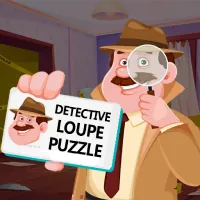
Detective Loupe Puzzle is a brain teaser wearing a detective coat. Each case gives you a picture and a question, and the answer is always somewhere in the picture rather than in any knowledge you were expected to bring.
The catch is that the cases are built to punish the first thing you notice. A scene will present an obvious suspect, an obvious clue, an obvious reading, and the actual answer sits half a step to the side of it.
Some cases are hidden object hunts, some are spot the difference, some are pure logic, and some are jokes. You are not told which kind you are looking at, and that is the game.
How to play Detective Loupe Puzzle
Every level shows a scene and asks a single question.
- Look over the whole picture before answering.
- Tap or click the person, object or detail that answers the question.
- Some cases ask you to find something hidden rather than to identify a culprit.
- Wrong answers usually let you try again, so exploring is safe.
- A hint is available when a case will not move.
The kinds of case
- Identify the culprit from something visible in the scene.
- Find an object that has been hidden in plain sight.
- Spot what changed between two versions of the same picture.
- Answer a question where the trick is in how it was worded.
The magnifying glass
Detective Loupe notices things you would miss, and the game uses that as a hint system. When a detail is genuinely too small to see, the loupe is the intended route rather than a failure on your part.
Tips and strategy
Read the question twice
More cases are lost to careless reading than to careless looking. A question asking who is lying is a different question from who did it, and the scene will happily support the wrong answer to the wrong question.
The wording is part of the puzzle. When a case seems to have no solution, the fault is usually in what you think you were asked.
Look at hands, clothes and shadows
The details these puzzles hide answers in are consistent. Somebody wearing the wrong thing for the weather. A shadow falling in the wrong direction. A right handed action performed with a left hand. Something clean in a place where everything else is dirty.
Once you know the vocabulary of the genre, half the cases resolve in a few seconds.
Distrust the crowded corner
Scenes are drawn with a busy area that pulls your eye. Sometimes the answer is in it, more often it is there to hold your attention while the real detail sits in an empty part of the frame.
Deliberately look at the boring regions of the picture. That instruction alone solves a surprising number of cases.
Count what should match
When two of something appear, compare them. Two windows, two shoes, two identical characters, two halves of a pattern.
Anything that should be symmetrical and is not is almost always deliberate.
The joke cases
Some puzzles have answers that are pure wordplay, where the picture is a pun rather than a scene. These are unfair by design and the only defence is recognising the type.
If a case looks trivially simple and your obvious answer is rejected, you are in a joke case. Stop looking for evidence and start looking for the pun.
Spend hints on the hunts
The hidden object cases are the ones where you can be stuck for a long time without learning anything, because there is no reasoning to do, only searching.
The logic cases are the opposite. A hint there takes away the whole puzzle, so those are the ones worth sitting with.
Why the cases feel unfair at first
The first several puzzles will annoy you, and that reaction is worth understanding rather than pushing through.
Puzzles like these are built on a small set of conventions. The answer is always visible. The obvious suspect is rarely correct. Anything drawn with unusual care is significant. A question worded strangely was worded that way deliberately.
Nobody explains these conventions, so early cases feel arbitrary. After a dozen of them the conventions become obvious, and the same puzzles that seemed unfair start reading like a language you know.
That is why it is worth playing past the first frustrating stretch rather than concluding the game is badly made. The difficulty curve here is not about the cases getting harder, it is about you learning what kind of thing you are being asked, and it flattens out quickly once you do.
More brain teasers here
Hidden Objects Brain Teaser is the pure searching version, Hidden Cats Detective Agency keeps the detective framing, and The Impossible Quiz Classic is the same trick questions without the pictures. More in quiz and hidden-objects.
More games like this
Play our free daily puzzles
See all →Made by us. One a day, the same for everyone, no sign up.
Last updated
Frequently asked questions
What kind of game is Detective Loupe Puzzle?
A mixed brain teaser. Cases can be logic problems, hidden object hunts, spot the difference scenes or wordplay, and you are not told which kind you are facing.
Do I need outside knowledge to solve a case?
No. Everything needed is in the picture and the question, which is why rereading the wording is usually more productive than thinking harder.
What details do the puzzles usually hide the answer in?
Clothing that does not suit the setting, shadows pointing the wrong way, something too clean or too new, and pairs of things that should match but do not.
Are wrong answers punished?
Generally not, so exploring the scene is safe. The cost of a wrong guess is time rather than progress.
When should I use a hint?
On the searching cases, where being stuck teaches you nothing. On the logic cases a hint removes the puzzle entirely.
Is it free?
Yes, free in the browser with no download and no account.