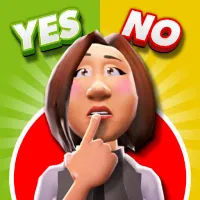
Yes or No Challenge

Free daily card games
A new deal every day, solved before it goes live, so it can always be won.

Yes or No Challenge
A quiz where every question has exactly two possible answers is a strange thing to build, because a coin flip gets half of them right. Yes or No Challenge works anyway, and it is worth understanding why before playing it.
With two options and a clock, the game stops being about knowledge and starts being about speed of recognition. You either know it immediately or you are guessing, and the interesting part is how quickly you can tell those two states apart in yourself.
It runs single player or with two people sharing the keyboard, and the two player mode is where it comes alive, because now the coin flip has a cost.
How to play Yes or No Challenge
A statement appears. You decide whether it is true.
- Choose yes or no before the timer runs out.
- A correct answer scores and moves on.
- A wrong answer costs you, and so does running out of time.
- In two player mode, both players answer the same question and the faster correct answer wins the point.
- Gifts and surprises are handed out as you progress, which is the game's way of pacing the difficulty.
The two player mode
Two people, one keyboard, separate keys. Both see the same question and both are racing.
This changes the maths entirely. Alone, a guess is worth half a point on average and costs nothing but time. Against somebody, a guess that is wrong hands them the point outright, so the correct play is to answer instantly when you know and to answer anyway when you do not, because a slow correct answer loses to a fast one.
Why the timer matters more than the questions
Most of the questions are answerable by most people. What decides the score is how long you take to be sure.
The gap between knowing something and being confident enough to press is about a second, and that second is the whole game.
Tips and strategy
Answer first, doubt later
The single most damaging habit in a two option quiz is re-reading the question. Your first read produced an instinct, and on true or false statements that instinct is right far more often than the second thought that overrules it.
Re-reading changes an answer roughly as often as it corrects one, and it always costs time.
Learn the shape of a false statement
Statements built to be false usually carry a tell.
- Absolute words. Always, never, all, none, every. Real facts rarely survive them.
- A precise number attached to something no one measures precisely.
- Two true halves joined by a wrong connector, where the fact is right and the reason is not.
- Something almost right, with one name or date swapped.
Statements built to be true tend to be plainer, because the writer had nothing to hide.
Playing against somebody
- Decide before the round whether you are playing to win or to be right. They are different.
- If you are ahead, answer only what you know. Let them take the risk.
- If you are behind, answer everything immediately. A guess is your only way to close a gap.
- Watch their rhythm. A player who hesitates on a category is telling you they will hesitate again.
The cost of a wrong answer is not the point lost
In a timed quiz, a mistake costs twice. You lose the point, and you lose the rhythm.
Players who get one wrong tend to slow down on the next three, second guessing themselves, and that hesitation costs more than the original error. Watch for it in yourself. If you notice you are re-reading after a mistake, deliberately answer the next question fast even if you are less sure, just to break the pattern.
Confidence is a mechanic here in a way it is not in an untimed quiz.
Playing alone
Alone, the pressure is different and so is the correct approach. Nobody is taking the point off you, so a couple of extra seconds costs less. Use them on the statements that feel almost right, because that is where the questions are actually trying to catch you.
Skipping through easy ones quickly is what buys that time.
Categories repeat, so learn them
Questions are drawn from a set of subject areas, and after a few rounds you will notice which ones you are good at and which ones you keep losing.
That is more useful than it sounds. Knowing that you are reliable on geography and shaky on sport tells you where to answer instantly and where to spend an extra beat. In two player mode it also tells you when to fire immediately and when to let the other person commit first.
Most people never notice this because they experience the quiz as a stream of unrelated facts. It is not. It is four or five buckets, and your accuracy is very different in each one.
What the surprises are for
The gifts and bonuses are a pacing device rather than a mechanic to plan around. They arrive to break the rhythm of question and answer, and treating them as something to optimise is wasted effort.
Other quizzes here
The Impossible Quiz is the opposite design, where the questions are deliberately unfair and knowledge barely helps. Guess It sits in the middle, giving you clues rather than statements. More in quiz and trivia.
More games like this
Play our free daily puzzles
See all →Made by us. One a day, the same for everyone, no sign up.
Last updated
Frequently asked questions
How many players can play?
One or two. In two player mode both people share the keyboard, answer the same question, and the faster correct answer takes the point.
Is guessing worth it?
Alone, yes, since a wrong answer only costs you that question. Against another player it is riskier, because a wrong guess hands them the point.
Should I re-read a question I am unsure about?
Usually not. On true or false statements the first instinct is right more often than the second thought, and re-reading always costs time.
How do I spot a false statement?
Look for absolutes like always and never, oddly precise numbers, or a true fact attached to a wrong reason. Statements meant to be true are usually plainer.
What are the gifts for?
They are a pacing device that breaks the rhythm between questions rather than a mechanic worth planning around.
Is it free?
Yes, free in the browser with no download and no account.