Word Search Puzzles
A new themed grid every day, plus the endless versions and the variants that let words turn corners. Free to play, and every daily puzzle prints on one sheet.
Today's puzzle A new grid every morning, the same one for everybody playing that day.






Puzzles by theme
Every one of these plays in the browser and prints on a single sheet, with the answer key kept on a separate page.
 Animals
  Farm Animals
  Ocean Animals
  Birds
Birds  Insects
  Dog Breeds
  Dinosaurs
  Fruits
  Vegetables
  Breakfast
  Desserts
  Baking
  Pizza
Pizza  Drinks
  Christmas
  Halloween
  Easter
  Thanksgiving
  Birthday
  New Year
  Weather
  Flowers
  Trees
Trees  Space
Space  Beach
Beach  Camping
  Gardening
  Rainforest
  School Supplies
  Math
Math  Science
  Human Body
  US States
  Countries
  Music
Music Sports
 Sports
  Soccer
  Olympics
  Winter Sports
 Everyday Life
 Kitchen
  Clothing
  Jobs
Jobs  Transportation
  Colors
  Emotions
  Travel
  Movies
  Around the House
 The puzzle that asks nothing of your vocabulary
A word search gives you the answers before you start. The list is printed beside the grid, and the only task left is finding each word among the letters.
That is the whole reason the format has outlasted everything around it. There is no clue to misread, no answer to be embarrassed about, and no way to be stuck in the sense that other puzzles allow. It is the one word puzzle that is genuinely relaxing rather than merely quiet.
It is also the reason teachers, hospitals and care homes use them. The difficulty can be tuned by grid size and word count without ever making the task confusing.
How to find words faster
There is technique here, even though the puzzle looks like pure looking.
- Hunt the rare letters. Any word containing a J, Q, X or Z is found by scanning for that one letter, because there are only a handful in the grid.
- Scan columns and diagonals on purpose. Eyes read left to right by default, so the vertical and diagonal entries are the ones that survive three passes.
- Look for double letters. A repeated pair stands out at a glance and instantly locates words that contain one.
- Take the longest words first. They cover the most grid and they are the hardest to hide.
- Work the edges last. Words along the border are the most visible ones and they will still be there.
The habit that helps most people is to search for a letter rather than a word. Pick the first letter of the target and sweep the grid for it, then check the direction of each candidate. Searching for the shape of a whole word is slower and it misses reversed entries.
The daily grid and the printable sheet
Daily Word Search puts up a new themed puzzle each day. The theme is the point rather than the decoration: a grid about kitchen tools and a grid about rivers feel different to solve, because the words in one share letter patterns that the words in the other do not.
Every themed puzzle on the site prints on a single sheet, with the answer key on a separate page. That is deliberate, and it is why the printable versions get used in classrooms and activity groups where a screen is not wanted.
The variants worth knowing
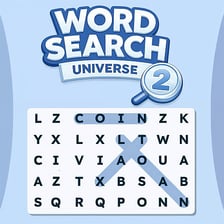
Word Search Universe 2 is the endless version, with grids that keep arriving so long as you keep solving.
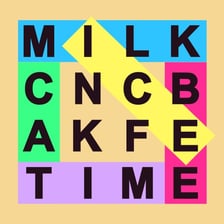
Fillwords breaks the straight line rule. Words bend around corners and every letter in the grid belongs to exactly one word, which turns a search into something closer to a jigsaw. It is a good next step once plain grids have become automatic.
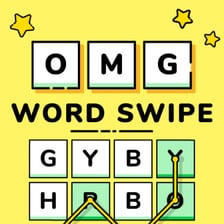
Wander Words and Word Jungle sit between the two, keeping the search feeling while adding a light objective on top.
Themes, and why they change the difficulty
A word list drawn from one subject is harder than a random list, and most people find this counterintuitive.
The reason is interference. Words about the same topic share prefixes, endings and letter runs, so the grid contains near misses that read as the word you are hunting until you check the last two letters. A random list has no such traps.
So a themed grid of fifteen words is usually slower than a random grid of twenty. If a puzzle feels harder than its size suggests, that is why, and it is not a sign that you have lost the knack.
Why classrooms and activity groups use them
The printable versions get used far more than the on screen ones in some places, and the reason is worth understanding even if you only ever solve them on a phone.
A word search can be graded without changing what it asks. A larger grid, more words, more diagonal and reversed entries, all of these raise difficulty without making the instructions any harder to follow. Almost no other puzzle scales that cleanly, which is why the same format works for a six year old and for a group of adults.
It also finishes. A crossword can be abandoned unsolved and that feels like a failure. A word search always ends with every word found, and for a lot of people that is the point of doing one.
On a small screen
Word searches are the best word puzzle on a phone, because they need one finger, no precision and no typing.
The only thing worth adjusting is how you hold it. Rotating the phone to landscape usually shows the whole grid at once, and seeing the entire grid is worth more than seeing any part of it larger.
Frequently asked questions
Is there a new word search every day?
Yes. The daily puzzle puts up a fresh themed grid each day, and the endless versions never run out.
Can I print the word searches?
Yes. Every themed puzzle prints on a single sheet, with the answer key on a separate page.
What is the fastest way to find a word?
Search for one letter rather than the whole word, and start with rare letters such as J, Q, X and Z. Then check the direction of each candidate.
Do the words go backwards and diagonally?
Yes, in most grids. Vertical, diagonal and reversed entries are the ones people miss, because eyes read left to right by default.
Why does a themed grid feel harder than a bigger random one?
Words on one subject share prefixes and endings, so the grid is full of near misses. A random list has no such traps.
Are word searches good for children?
They are one of the best puzzles for a young solver, because the words are given and there is no wrong answer, only a word not yet found.
Do I need an account to play?
No. Nothing here asks you to register, and there is nothing to install.