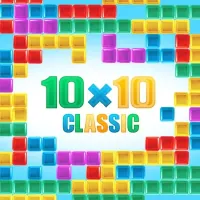

10x10




Free daily card games
A new deal every day, solved before it goes live, so it can always be won.

10x10
10x10 takes the shapes from Tetris and removes the thing everyone remembers about Tetris: the falling.
Nothing descends. Three shapes wait at the bottom of the screen and they will wait as long as you want. You place one, then another, then the third, and a new set appears. Complete a row or a column and it clears.
Taking away the time pressure sounds like it makes the game easier. It does the opposite. In a falling block game you lose because you were too slow. Here there is nothing to blame but the placement you made four moves ago, and the board fills up because of decisions rather than reflexes.
- Three shapes are offered below the grid.
- Drag a shape onto the board. It must fit entirely in empty cells.
- Fill a complete row or column and it clears.
- New shapes appear once all three have been placed.
- The game ends when none of the offered shapes will fit anywhere.
How to play 10x10
Pieces do not rotate
This is the rule that defines the whole game. The shape you are given is the shape you must place. A long piece stays long, an L stays in its orientation.
That means your board has to accommodate shapes rather than the shapes accommodating your board, and it is why leaving awkward gaps is so much more punishing here than in a game where you can turn a piece to fit.
Order matters more than position
You are given three shapes at once and you may place them in any order. That freedom is the main skill in the game.
The common mistake is placing them left to right as they appear. Look at all three first: often the second shape only fits after the third has cleared a line, and placing them in the wrong order costs you the whole set.
For the version with a sudoku grid underneath, try Sudoku Blocks, and there are more of these on the puzzle page.
Tips and strategy
Board shape
- Build against the edges and keep the middle open. A hole in the centre blocks pieces from every direction, a hole at the edge blocks them from one.
- Never leave a single empty cell. One cell gaps can only be filled by one shape, and that shape may not arrive for ten turns.
- Keep a three by three area free if you can. The large square piece is the most common cause of a lost game and it costs very little to prepare for.
Choosing moves
- Prefer the placement that keeps your options open over the one that clears a line immediately. A cleared line is worthless if the next three shapes have nowhere to go.
- When two placements both clear a line, take the one that leaves the flatter board.
- Late in a game, count what actually fits before you place anything. Once the board is tight, one careless placement ends it.
Common mistakes
- Placing shapes in the order they appear rather than the order that works.
- Chasing double line clears at the cost of a ragged board.
- Filling the centre early because it is the easiest place to put things.
More games like this



Play our free daily puzzles
See all →Made by us. One a day, the same for everyone, no sign up.

Last updated
Frequently asked questions
Do the pieces fall in 10x10?
No. Nothing descends and there is no clock. The three shapes wait until you place them.
Can I rotate the shapes?
No. Each shape is placed exactly as it is offered, which is the constraint the entire game is built around.
When does the game end?
When none of the three offered shapes will fit anywhere on the board.
Does clearing two lines at once score more?
Yes, but it is rarely worth a ragged board. Keeping the grid flat matters more over a full game than any single clear.