
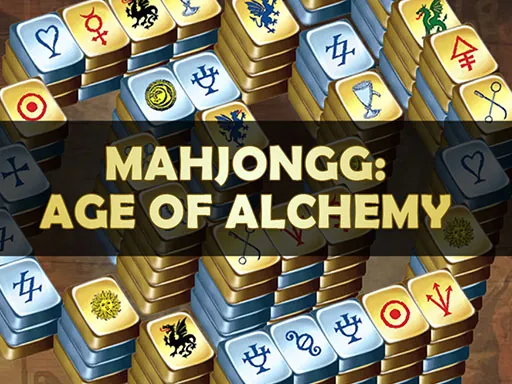
Arkadium's Mahjongg Alchemy

Free daily card games
A new deal every day, solved before it goes live, so it can always be won.




Arkadium's Mahjongg Alchemy
Mahjongg Alchemy is mahjong solitaire wearing an alchemist's workshop: sigils, vessels and old symbols in place of bamboo and characters, stacked into layouts that lean on the theme.
Worth saying plainly, since these games get sold on their artwork: the theme changes what the tiles look like and nothing about how the game works. What it does change is legibility, and that is not nothing. Symbols are easier to tell apart at a glance than nine near identical arrangements of green sticks, so the same layout plays faster here than it does with a traditional set.
The difficulty, as always, sits in the order you take the tiles.
How to play Arkadium's Mahjongg Alchemy
Tiles are stacked in layers. You remove them two at a time.
- Click one tile, then an identical one, to clear the pair.
- A tile can only be taken when it is free: nothing on top of it, and one of its left or right sides open.
- A tile boxed in on both sides is locked even though you can see it.
- Clear the whole layout to finish.
Why layouts, not tiles, set the difficulty
Every mahjong solitaire board is the same set of tiles. The only thing that varies between an easy game and a brutal one is the shape they are stacked in.
A wide, flat layout gives most tiles an open side from the start, so you have choices from the first move. A tall, dense one locks nearly everything under something else, and the whole game becomes a question of finding the one thread that unravels it.
Look at the silhouette before your first click. You will know within a second which kind of board you are on, and how carefully you need to play it.
Not every board can be won
This surprises people. Mahjong solitaire layouts are dealt at random within the shape, and some deals cannot be solved by any sequence of moves. Others are solvable but only by one narrow route.
That is not a flaw. It is why the shuffle button exists, and why restarting a board that has locked is a normal part of playing rather than an admission of defeat.
Tips and strategy
The one rule that matters
Take the pair that uncovers something. Leave the pair that does not.
Almost everything else in mahjong strategy is a restatement of that. Tiles along the outer edges of a layout are free at the start and stay free, so removing them early spends a move and buys nothing. Tiles under the top layer are the only ones that need your help.
Reading a board before touching it
- Find the highest layer. Those tiles are locking everything below them.
- Find the long single width rows. Each tile there is reachable from one end only, so their order is forced.
- Note which faces you can see four of. Those are your flexible pairs and worth saving.
- Only then start clearing.
The four copy problem
Every tile face exists four times in the set. When all four are visible and free, clearing two of them costs nothing. When two are free and two are buried, the free pair is the only thing that can ever match the buried ones.
Spend it carelessly and you have created a dead board without noticing. The instinct to build is: match a buried tile against a free one, and keep the second free tile as insurance.
Long rows
The single width rows down the middle of many layouts are where games die. Working from both ends at once feels efficient and strands whatever is in the middle.
Pick the end whose tile has a visible partner and work inward from there.
When it locks
If the remaining tiles all sit alone, each blocking another, there is nothing to find. Shuffle if you have one, restart if you do not.
Learning to recognise this position quickly is worth more than any amount of staring at it. The board will not open up because you looked harder.
Hint and shuffle are not free
Both buttons look like conveniences and both are better understood as a limited budget.
A hint shows one legal pair. Spend it the first time you hesitate and it will hand you the pair you were about to find anyway, and it will not be there when the board genuinely locks. Spend it only after a deliberate pass has failed, and it either saves the game or proves the board is dead.
Shuffle rescues a locked board and destroys whatever order you were working toward. It belongs at the end of the decision tree, never at the start.
Other layouts on the site
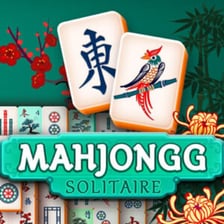
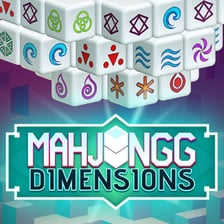
Mahjong Solitaire is the plain classic version, Garden Tales Mahjong is the softer themed one, and Mahjong Dimensions 900 Seconds puts the tiles on a rotating block with a clock attached. The whole set is in mahjong, with more in puzzle.
More games like this



Play our free daily puzzles
See all →Made by us. One a day, the same for everyone, no sign up.
Last updated
Frequently asked questions
Which tiles can I remove in Mahjongg Alchemy?
Only free ones: nothing stacked on top, and at least one of the left or right sides open. A visible tile is not necessarily a free tile.
Does the alchemy theme change the rules?
No. It changes the tile artwork and the layouts. The symbols are easier to tell apart than traditional suits, which makes the same board play a little faster.
Can a layout be impossible to finish?
Yes. Tiles are dealt at random within the shape and some deals have no winning route. Restarting is part of the game rather than a failure.
What should I clear first?
Whatever uncovers tiles beneath it. Edge tiles stay available all game, so clearing those early wastes your easy moves.
Why does the same game feel harder on some boards?
The layout shape, not the tiles. A tall dense stack locks almost everything, a wide flat one gives you choices from the first move.
Is it free?
Yes, free in the browser with nothing to install and no account.