
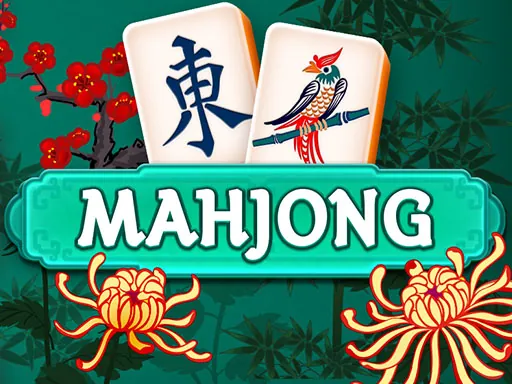
Arkadium's Mahjong



Free daily card games
A new deal every day, solved before it goes live, so it can always be won.






Arkadium's Mahjong
The game everybody calls mahjong online is not the four player game with hands and winds. It is mahjong solitaire: one player, one hundred and forty four tiles stacked into a shape, and a single rule about which of them you are allowed to touch.
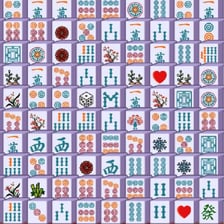
Arkadium has been making this game for a long time and it shows in the parts you stop noticing after a minute. Tile faces are legible at small sizes, the stack reads as three dimensional without fighting your eye, and the free tiles are visually distinct from the locked ones. That last point sounds trivial and it is the difference between a game you can play quickly and a game where you keep clicking tiles that refuse to move.
What it does not do is make the game easier. The layout still reaches dead positions, the middle spine is still where runs go to die, and the hint button will still not save a board you dismantled in the wrong order.
How to play Arkadium's Mahjong
Tiles are stacked in layers. You remove them two at a time, and only tiles that are free may be taken.
- Click one tile, then click an identical tile to remove the pair.
- A tile is free when nothing rests on top of it and either its left or its right side is open.
- A tile with neighbours on both sides is locked, even though you can see it perfectly well.
- Flower tiles match any other flower. Season tiles match any other season. Everything else needs an exact twin.
- Clear all one hundred and forty four tiles to win.
Hint, shuffle and undo
Three buttons sit under the board and all three are limited resources rather than conveniences.
Hint shows you one legal pair. On a board you have not searched properly it removes the pair you would have found anyway.
Shuffle rearranges what is left. It rescues a genuinely dead board and it also destroys whatever plan you had, so it is a last resort rather than a reset button.
Undo takes back the last move. It is the most useful of the three, because the mistakes in mahjong are almost never the pair you took, they are the pair you took first.
Reading the stack
The tiles you can see in the middle of the layout are almost all locked by the layer above them. The playable ones are the ends of the long rows and the tops of the stacks.
Beginners scan for matching pictures across the whole board. Faster players scan for free positions first and only then read what is sitting in them, which is a much smaller search and gets quicker with practice.
Tips and strategy
Dig, do not skim
The single most common way to lose is to clear every easy pair along the outside edges. Those tiles were free at the start and would still have been free at the end. Spending them early buys you nothing and leaves the buried core untouched.
Every pair you take should ideally uncover something. When two matches are both legal, take the one that frees more tiles, even when it is the harder one to spot.
The problem with four copies
Almost every tile face exists four times. That sounds generous and it is the source of most lost games.
- When all four copies are free, clearing both pairs is safe.
- When two are free and two are buried, taking the free pair can strand the buried ones for good.
- The rule of thumb: match a buried copy against a free one whenever you can, and keep the easy pair in reserve.
The middle spine
Most classic layouts have a row down the centre that is one tile wide. Each tile there is only reachable from one end, which means the order you take them in decides whether the rest come out at all.
Work from whichever end has a tile whose partner you can already see. Opening both ends at once feels productive and usually strands something in the middle.
Knowing when it is over
Mahjong solitaire layouts can reach positions with no legal move, and no amount of staring fixes that. The signs are a small number of tiles left, each in a single stack, with the remaining faces split across positions that block one another.
Recognising that and restarting is a skill, not a surrender. Shuffle exists for exactly this moment, and it is the one time using it is clearly correct.
If you want a different board
Classic Mahjong is the same rules with the traditional turtle. Mahjong 3D puts the tiles on a block you rotate, which adds a memory problem on top of the matching one. Mahjong Firefly is the quiet night time version, and the full mahjong collection has the seasonal layouts.
More games like this



Play our free daily puzzles
See all →Made by us. One a day, the same for everyone, no sign up.



Last updated
Frequently asked questions
What makes a mahjong tile free?
Nothing may be stacked on top of it, and at least one of its left or right sides must be clear. A tile you can see plainly may still be locked by neighbours on both sides.
Do flower and season tiles match each other?
Any flower matches any other flower, and any season matches any other season. They are the only tiles that do not need an exact twin.
How many tiles are in a game?
One hundred and forty four, the full mahjong set, arranged into a layered layout.
Is this the same as the four player mahjong game?
No. This is mahjong solitaire, a single player matching puzzle that borrows the tiles. The four player game with hands, winds and dragons is a different game entirely.
Can I get stuck with no moves left?
Yes. When the remaining tiles block one another there is no legal pair, which is what the shuffle button is for. If shuffling does not open anything, restarting is the right call.
Is Arkadium Mahjong free to play here?
Yes. It runs in the browser with no download, no account and no payment, on desktop and on phones.