
Arkadium's Mahjongg Candy Cane

Free daily card games
A new deal every day, solved before it goes live, so it can always be won.




Arkadium's Mahjongg Candy Cane
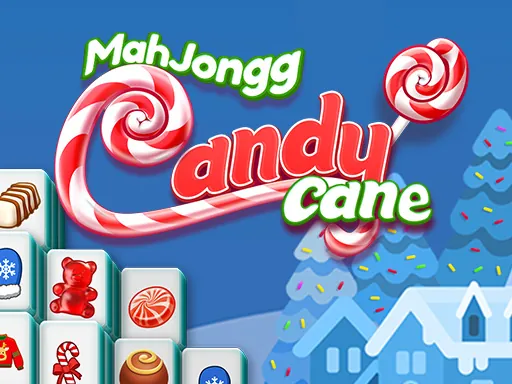
Snow, gingerbread, gummy bears and candy canes, stacked into a mahjong layout. Mahjongg Candy Cane is Arkadium's winter reskin of the game they make year round, and the rules underneath have not moved an inch.
Which raises the fair question of why anyone would play a reskin. There is an answer, and it is not the snow.
How to play Arkadium's Mahjongg Candy Cane
- Find two identical tiles on the board.
- Check that both are free, meaning nothing sits on top and one side is open.
- Click one, then the other, and the pair disappears.
- Keep going until the layout is empty.
Flowers match any flower, seasons match any season. Hint, shuffle and undo sit under the board and all three are worth saving rather than spending on the first hesitation.
Why the sweets matter
The reason to play this version rather than the classic one is legibility.
A traditional mahjong set is built from three suits that repeat with small variations: circles, bamboo sticks and Chinese characters, each running one to nine. The bamboo suit in particular is nine faces made of the same green sticks in different arrangements, and telling six from seven at a glance takes practice most players never get.
Candy Cane replaces all of that with objects. A gummy bear is a gummy bear. A mitten is a mitten. There is no counting, no near identical pair, and no misreads.
The effect is that the same board plays noticeably faster, and the difficulty moves entirely to where it belongs: the order in which you take the tiles.
Tips and strategy
The layout is the difficulty
Seasonal mahjong games usually change the shape of the stack along with the artwork, and shape is what actually sets the difficulty in this game.
A wide, shallow layout is forgiving, because most tiles have an open side from the start. A tall, narrow one is punishing, because almost everything is locked under something else. Look at the silhouette before your first click and you will know which kind of board you are on.
Spend the opening on the middle
Tiles along the outer edge are free now and will still be free in ten minutes. Nothing about them changes. Tiles under the top layer only become playable if you dig.
So the correct opening is the counterintuitive one: ignore the easy pairs your eye finds first, and take the pairs that uncover something. Players who clear the outline first tend to stall with a dozen tiles left, all of them blocking each other.
Choosing between two legal pairs
- Take the pair that frees the most tiles underneath it.
- Between two pairs that free the same amount, take the higher one in the stack.
- If a face has four copies and only two are free, think before you take them. You may be spending the copies that would have matched a tile you cannot reach yet.
Recognising a dead board
Every mahjong layout can reach a position with no legal pair left, and no amount of looking will change that. The signal is a handful of tiles remaining, each sitting alone in its own stack, with the surviving faces split between positions that block one another.
That is the moment shuffle exists for, and the only moment using it is clearly right.
The three buttons
Undo is the one worth using. Mahjong mistakes are almost always about order rather than choice, and stepping back two moves often reveals that a different pair should have gone first.
Hint is worth spending only after a full, deliberate pass has found nothing. Used at the first pause, it teaches you nothing and it is not there when the board genuinely locks.
Shuffle is the emergency exit. It rescues a dead board and it also throws away every plan you had, so it belongs at the end of the decision tree rather than the start.
What actually slows people down
It is almost never the search for a matching pair. It is the search for a matching pair among tiles that turn out to be locked.
The habit worth building is to reverse the order. Instead of scanning the board for two identical sweets and then checking whether either can move, scan for the tiles that are free, and only then read what is on them. There are far fewer free tiles than tiles, so the search is smaller, and every candidate it produces is one you can actually play.
On a phone the same principle matters more, because the board is smaller and a mis-tap costs you a moment of hunting for where you were.
Seasonal but not seasonal
Nothing in the game checks the calendar. The winter theme is artwork, so a Candy Cane board in July plays exactly like one in December.
If you want the rest of the seasonal set, Winter Mahjong leans on snow and ice, Valentine Mahjong uses hearts and heart shaped layouts, and Arkadium's Mahjong is the same engine with the traditional tiles if you would rather learn to read the real suits. Everything else is in mahjong.
More games like this



Play our free daily puzzles
See all →Made by us. One a day, the same for everyone, no sign up.


Last updated
Frequently asked questions
Is Mahjongg Candy Cane different from normal mahjong?
The rules are identical. What changes is the artwork and the layouts, and the sweets are considerably easier to tell apart than traditional mahjong suits.
Which tiles am I allowed to remove?
Only free ones. A tile is free when nothing rests on top of it and at least one of its left or right sides is open.
Can I play it outside the winter holidays?
Yes. Nothing in the game checks the date, so it plays the same in any month.
What should I clear first?
The stacked middle of the layout, not the outline. Edge tiles stay available throughout, so clearing them early spends your safe moves for nothing.
What does the shuffle button do?
It rearranges the remaining tiles. It saves a board with no legal moves left, but it also discards whatever order you were working toward, so it is a last resort.
Is it free?
Yes, free in the browser with nothing to install and no account.