

Classic Solitaire




Free daily card games
A new deal every day, solved before it goes live, so it can always be won.


Classic Solitaire
 Our free daily · new every day Solitaire One winnable deal a day Play now
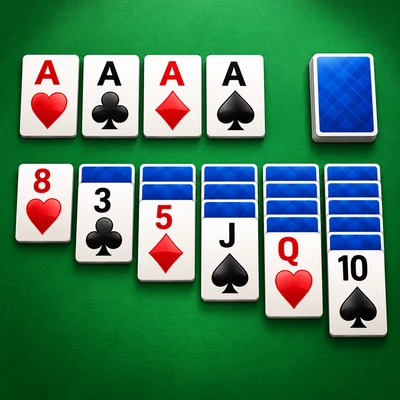
 Classic Solitaire is Klondike, the layout that shipped with every office computer for two decades and taught most people what solitaire is.
Seven columns, twenty eight cards, of which twenty one are face down. Four empty foundations waiting for aces. The rest of the deck in your hand. The whole game is about turning face down cards face up, and every decision should be judged against that.
If you would rather play a version where almost every deal can be won, FreeCell Solitaire is the one to open, and there are more of them in cards.
How to play Classic Solitaire
- Move cards between the seven columns in descending order, alternating red and black.
- Build the four foundations upwards by suit, starting with the ace.
- Only a king can be moved into an empty column.
- Turn over the stock when the board has nothing left to give.
- The game is won when all fifty two cards sit on the foundations.
Sequences move together
A run of cards already in order and alternating colour moves as a unit. That is not a convenience, it is a tool: a long run parked on the wrong card can be lifted off in one move once a better home appears.
The stock
The talon is not a bonus, it is a limited resource. How many times you may run through it decides whether a deal is generous or brutal, and it is worth knowing before you spend cards carelessly early on.
Tips and strategy
The single rule that matters
Every move should aim at a face down card. A move that tidies the board without exposing anything new has usually cost you a tempo you needed later.
Choosing between two legal moves
- Prefer the move that uncovers a face down card.
- Between two of those, prefer the one from the longest column, because that is where the buried cards are.
- Prefer a move that does not commit a card you might want elsewhere.
- If neither move reveals anything, deal from the stock instead.
Aces and low cards
Send aces and twos up immediately, they can never be useful on the tableau. Everything above that is a judgement call. A five sent to the foundation too early is a five that cannot hold the four you turn over two moves later, and that is how a winnable deal dies.
Empty columns
An empty column is the most valuable thing on the board and the easiest to waste. Do not fill it with the first king you happen to hold. Fill it with the king that unblocks the column you actually need to dig into, and if none of them do, leave it empty and keep it as somewhere to unload a run.
Habits that lose deals
- Emptying a column and immediately filling it out of tidiness.
- Sending mid value cards to the foundations because there is nothing better to do.
- Playing the first legal move you notice rather than looking at all of them.
More games like this


Play our free daily puzzles
See all →Made by us. One a day, the same for everyone, no sign up.

Last updated
Frequently asked questions
Is Classic Solitaire the same as Klondike?
Yes. Klondike is the formal name for the seven column game most people simply call solitaire.
Can every deal be won?
No. Klondike deals a proportion of hands that cannot be solved no matter how well you play, which is part of the character of the game.
What can go into an empty column?
Only a king, or a sequence with a king at its head. That restriction is what makes empty columns worth planning for.
Should I always move aces to the foundation?
Aces and twos, yes, since they can never help on the tableau. Higher cards are worth holding back, because they may be needed to accept cards you have not turned over yet.
Does it cost anything?
No. It is free in the browser, with no download and no sign up.